The benefits of using AI and implementing AI in preventing product recalls – Part 3
AI plays a crucial role in preventing product recalls by enabling companies to analyse vast amounts of data and detect potential issues before they escalate. Here are some key benefits of using AI in quality control and recall prevention:
Improved accuracy: AI algorithms can analyse data with accuracy that surpasses human capabilities. They can detect subtle patterns and anomalies that may indicate a potential defect, allowing companies to address the issue before it becomes more significant.
Faster detection: AI algorithms can process large datasets in a fraction of the time it would take a human operator. This speed enables real-time monitoring and immediate action, reducing the risk of defective products reaching the market.
Reduced false positives: AI algorithms can be trained to minimise false positives, ensuring that only genuinely defective products are identified. This reduces unnecessary product rejections and streamlines the quality control process.
Predictive analytics: AI-powered predictive analytics can identify trends and patterns that may lead to recalls. By analysing historical data, AI algorithms can predict potential issues and recommend preventive measures, allowing companies to address them proactively.
Cost savings: By preventing recalls, companies can avoid the financial costs associated with refunds, replacements, and regulatory penalties. Additionally, AI can optimise processes and minimise waste, resulting in further cost savings.
Implementing machine vision and AI in the South African FMCG industry
Implementing machine vision and AI technologies in the South African FMCG industry requires careful planning and consideration. Our AI technologies include edge learning and deep learning tools that automate inspection applications by learning to spot patterns and anomalies from reference images. The tools solve tasks that are too complicated and time-consuming to program with rule-based algorithms while providing consistency and speed that aren’t possible with manual inspection. Our AI technology tolerates natural variation and differentiates between acceptable and unacceptable anomalies to simplify the development of highly variable applications. Here are some key steps companies can take to integrate these technologies into their operations successfully:
Assessing the specific needs: Companies should evaluate their quality control processes and identify the areas where machine vision and AI can provide the most significant benefits. This assessment should consider factors such as the volume of production, the complexity of products, and the specific quality requirements.
Selecting the right technology: Various machine vision systems and AI platforms are available. Companies should carefully evaluate their options and select the technology that best aligns with their needs and budget. Choosing a solution that offers scalability, flexibility, and ease of integration with existing systems is crucial.
Preparing the infrastructure: Implementing machine vision and AI technologies may require upgrading the existing infrastructure. This may include installing cameras, sensors, and data storage systems. Additionally, companies should ensure that their network infrastructure can handle the increased data flow generated by these technologies.
Training the system: Machine vision systems and AI algorithms require training to achieve optimal performance. Companies should provide the system with a diverse dataset of images and data from which to learn. This training process should be ongoing, allowing the system to improve its performance and adapt to new product variations continuously.
Integration with existing systems: Machine vision and AI technologies should seamlessly integrate with existing quality control processes and systems. This integration ensures data is shared across different departments and enables real-time monitoring and response.
Continuous monitoring and improvement: Implementing machine vision and AI is ongoing. Companies should continuously monitor and evaluate the performance of these technologies, identifying areas for improvement and making necessary adjustments. Regular software updates and maintenance are essential to ensure optimal performance and accuracy.
Solution example - Automated Meat & Poultry Inspection
Organic meats and poultry are premium products sold to discerning customers but are still packaged in large volumes with automation machinery. The label on the cut of meat or poultry parts must be accurate. Accurate classification also ensures that the appropriate price is charged for each cut. Industrial packaging still suffers from the possible inclusion of physical contaminants.
Organic meat and poultry vary more in size, colour, and other aspects than factory-raised products because of the range of ways in which they are raised and slaughtered. These variations in appearance make it difficult for conventional machine vision to accurately solve visual meat classification applications, particularly when they have already been packaged with a wrap containing a visually confusing logo with printing on it.
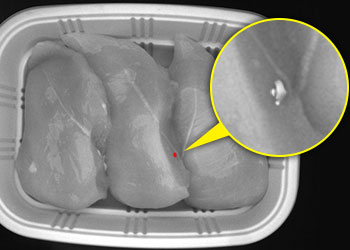
X-ray scanning can find metal contaminants, but plastic or polystyrene foam must be identified visually. Given their random appearance and location, conventional machine vision often misses such contamination.
AI-based vision systems and software are effective solutions for meat quality inspection. The system is trained on labelled sets of images of each meat cut or poultry part to identify the defects. The classification tool will then accept the range of natural variation while accurately classifying each piece, ensuring that no part is graded lower than it should be so the product can be sold at the highest fair price.
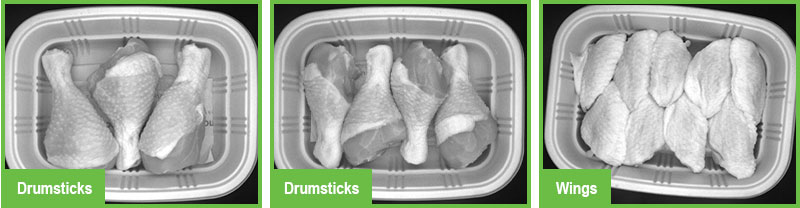
The defect detection tool quickly spots any bits of physical contamination, whether from damaged packaging, machinery, or other sources and flags them before the product moves on to shipping. This ensures that all cuts shipped are classified and priced correctly, improving both customer satisfaction and revenues.