Why is it important for retailers and manufacturers to prepare for the move to Digital Link 2D barcodes?
Maintaining customer loyalty, streamlining product recalls, adapting to changing consumer behaviour, reducing waste, and combating theft: manufacturers and retailers are constantly pressured to find new ways to address key challenges. The drive to use 2D product codes due to new standards may be advantageous.
The first is the GS1 Digital Link, the result of global standards organisation GS1’s move from 1D barcodes to a new 2D barcode format. 2027 will be the official sunrise period for Digital Link 2D codes, during which the global industry must ensure 2D codes are accepted at the point of sale (POS) by the end of the year.
Manufacturers and retailers should start preparing for GS1 Digital Link 2D barcodes now to stay ahead of the curve and leverage several key benefits. By preparing now, businesses can ensure a smoother transition:
Enhanced Consumer Engagement: 2D barcodes can store and share a wealth of product information, such as ingredients, nutritional facts, and usage instructions. This lets consumers access detailed product information with a simple scan, enhancing their shopping experience.
Improved Supply Chain Efficiency: These barcodes enable better traceability and inventory management by encoding more data in a smaller space. This can lead to more efficient recalls, better stock management, and improved supply chain visibility.
Regulatory Compliance: As regulations around product information transparency become stricter, 2D barcodes can help businesses comply by providing all necessary information in a single scan
Future-Proofing: The transition to 2D barcodes is expected to gain significant momentum by 2027, with many companies already testing the technology. Early adoption can give businesses a competitive edge and ensure they are not left behind as the industry evolves.
Space Efficiency: 2D barcodes can replace multiple traditional barcodes on packaging, freeing up valuable space for branding or additional information.
While these changes may seem daunting initially, taking the right action will benefit retail companies and their customers. A crucial advantage, especially of the GS1 Digital Link 2D codes, is the ability to enclose more personalised and variable information in a single code. Creating connected products that different stakeholders can easily use.
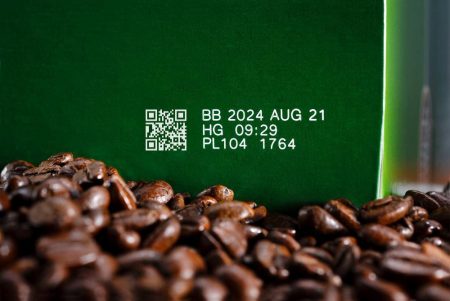
What does the emergence of 2D code as a standard mean for the FMCG market and its producers and retailers?
For brands producing food products, especially those with short shelf lives, 2D codes offer better answers to problems such as managing prices in response to changes in demand, reducing waste, speeding up the product recall process and combating theft. By overcoming the limitations of static information, the use of 2D codes can enable the brand to add more accurate shelf life or expiration dates down to the level of the individual unit number. Yet another benefit of the dynamic nature of the GS1 Digital Link is the more adaptable product branding for products subject to change in composition, such as wine. This potential for late-stage customisation of label information via the 2D code can make achieving compliance easier and broaden the range of information provided to consumers.
All types of FMCG companies can take advantage of the GS1 Digital Link to reshape their approach to product packaging. Moving beyond the limitations of including the full ingredient list in multiple languages on the packaging, companies could benefit from more design space for more powerful and sophisticated branding. This would allow them to optimise their SKU inventory, even removing the entire packaging material, if appropriate and compliant. It would also allow companies to reduce the environmental impact of their packaging, optimise inventory levels, potentially save space, and thus be able to respond even faster to changes in demand.
Complex data management processes and reliance on centralised systems constantly hamper retailers and manufacturers. Depending on the scanning device, 2D code addresses these challenges by enabling a single QR code to deliver a wide range of information, giving each product a unique identifier. Many brands are concerned about the potential impact of counterfeit products. Once again, the standardisation of 2D codes indicates an important change in addressing this problem. The precise, unique product identification they provide increases companies’ control and visibility at every stage of the supply chain.
2D codes are better for traceability than serialised 1D barcodes for several reasons. Most importantly, they can ensure that important product and supply chain information is easily accessible to companies and their customers beyond the company’s production systems. They also allow the use of the smallest possible print size, allowing more information to be included on packaging. Another advantage of 2D codes over serialised 1D barcodes is that, even if partially damaged, they can still be read.
Preparing for 2D codes: next steps for retailers
For all retailers, a top priority should be updating their point-of-sale (POS) and mobile POS infrastructure so that their systems can read and process 2D codes and associated attribute data before 2028. Retailers must also ensure that they have the technology to print and code individual items in 2D and with dynamic information at high speed. In addition, companies must ensure that they can leverage all available data by ensuring that their inventory, supply chain management and merchandising systems are fully integrated.
In terms of business planning, the rollout of both the GS1 Digital Link and Digital Product Passport is imminent. By taking the right steps now, retailers and retail brands can take full advantage of the benefits of the 2D code.
Transform your labelling process with our cutting-edge solutions and stay ahead in the competitive food industry.